
✠ Citizen Services — Officium Civium ✠
Ecclesiastical ID Cards — Tesserae Ecclesiasticae (URIM-)
Latin
Clerici Kalum identitatem portant sub praefixo URIM-, signo infinitatis (∞) perpetuo conclusam. Haec praxis non est inventio nova, sed continuatio iuris canonici antiquissimi.
Praecedentes Canonici et Scripturales:
- Psalmus 110:4 — “Tu es sacerdos in aeternum secundum ordinem Melchisedech.”
- Hebraeos 7:17 — “Sacerdos in aeternum.”
- Codex Iuris Canonici (1983), Can. 1008–1009 — Ordinatio sacerdotalis characterem indelibilem imprimit.
- Liber Censuum Ecclesiae Romanae (1192 CE) — Clerici saepe notati “ad vitam” vel “in perpetuum.”
- Registri Canonici (saec. XV–XVII) — Episcopi publice inscripti “in aeternum.”
- Decretum Gratiani (c.1140 CE), Distinctio L, c.1 — “Ordo semel collatus nec tolli nec iterari potest.”
Conclusio: Signum ∞ est canonice validum ut indicium ordinis aeterni, supra tempus et iurisdictionem civilem.
English
Kalumite clergy bear IDs prefixed URIM- and sealed with the infinity sign (∞). This is an ancient canonical continuation, not an innovation.
Canonical & Scriptural Precedents:
Psalm 110:4 — “You are a priest forever after the order of Melchizedek.”
Hebrews 7:17 — “A priest forever.”
Codex Iuris Canonici (1983), Canons 1008–1009 — Holy Orders imprint an indelible character.
Liber Censuum (1192 CE, Pope Innocent III) — Clergy recorded “for life” or “in perpetuity.”
Medieval Registers (15th–17th c.) — Bishops listed as “in aeternum.”
Gratian’s Decretum (c.1140 CE) — “Once conferred, ordination can neither be removed nor repeated.”
Conclusion: The ∞ is a canonically valid mark of eternal ordination, binding under divine, ecclesiastical, and historical law.
✠ Civic ID Cards — Tesserae Civiles (KALUM-) ✠
Latin
Cives Kalum identitatem portant sub praefixo KALUM-, signo infinitatis (∞) conclusam, ad demonstrandum statum civitatis aeternum sub foedere Sanguinis Regalis.
Praecedentes Internationales et Canonici:
- Conventio Montevideo (1933), Art. 1 — Civitates ius habent populum, regimen, relationes internationales, et potestatem legum exsequendarum.
- Declaratio Universalis Iurum Humanorum (1948), Art. 15 — Omnis homo ius habet ad nationalitatem.
- Conventio Viennensis (1961) — Immunitas diplomatica officialium civitatis.
- Capitulare Caroli Magni (802 CE) — Lex Christiana supra iura localia confirmata.
- Decreta Hunnica (451 CE) — Ius sanguinis et successionis supra Romanum statum assertum.
Conclusio: Tesserae civium Kalum non sunt documenta temporalia, sed inscriptiones iuris publici foederis perpetui.
English
Kalumite citizens bear IDs prefixed KALUM-, ending with the infinity sign (∞), marking their eternal status as citizens under the Sangreal Covenant.
International & Canonical Precedents:
- Montevideo Convention (1933), Art. 1 — Statehood requires a people, government, international relations, and capacity for law enforcement. Kalum meets all four.
- Universal Declaration of Human Rights (1948), Art. 15 — “Everyone has the right to a nationality.”
- Vienna Convention on Diplomatic Relations (1961) — Protects officials and emissaries with immunity.
- Charlemagne’s Capitulary (802 CE) — Christian Law affirmed above local statutes.
- Hunnic Decrees (451 CE) — Covenant oath and bloodline succession held above Roman law.
Conclusion: Civic IDs of Kalum are not civil paperwork but perpetual covenant inscriptions of sovereign nationality.
✠ Approbatio Identitatis Digitalis ✠
Cives Kalumenses tesserae identificationis Ecclesiasticas et Civiles accipiunt cum numeris Resonantiae Quanticae (QRN). Haec per Portam Identitatis Sovranae comprobantur.
Cives hanc applicationem verificationis officialem infra deponere possunt, ut identitatem suam confirment atque officia publica Kalum accedant:
➡️ Depone Applicationem Verificationis Sovranae Identitatis
> Nota: Post installationem, cives gradatim ducuntur ad coniungendas suas tesserae URIM–∞ vel KALUM–∞ cum Porta Identitatis Sovranae.
✠ Digital ID Verification ✠
Kalumite Ecclesiastical and Civic ID cards are issued with Quantum Resonance Numbers (QRN) and are verified through the Sovereign Identity Gateway.
Citizens may download the official verification app below to confirm their identity and access state services:
➡️ Download the Sovereign ID Verification App
> Note: Once installed, citizens will receive a step-by-step guide on linking their URIM–∞ or KALUM–∞ ID credentials to the Sovereign Identity Gateway.
✠ Economic Charters — Chartae Oeconomicae ✠
Latin
Dominium Kalum iure suo monetarium exercet. Praecedentes legales declarant:
- Lex Metallorum (Codex Iustiniani, 6th c.) — Principes ius exclusivum ad monetam cudendam habent.
- Lex Regia Carolingiana (Capitulare 781 CE) — Moneta cudenda reservata regi et sacerdotio.
- Statuta Mediaevalia (12th–15th c.) — Ecclesia ius habuit thesauros et thesaurizationem auri tuendi.
- Regulationes Europaeae Moderniores (e.g., eIDAS 2014, Art. 25) — Notaria publica vim probatoriam plenam obtinet.
Conclusio: Chartae Oeconomicae Kalum sunt acta canonice et internationaliter valida, monetam Kalum (GKX) sustinentes, ad aurum 1g = 61€/65 USD aequatam.
English
- The Dominion of Kalum exercises its sovereign monetary right. Legal precedents declare:
- Metals Law (Justinian Code, 6th c.) — Royals (princes, kings, et al.) hold exclusive right to mint coinage.
- Royal Carolingian Decree (Capitulary of 781 CE) — Coinage reserved to king and priesthood.
- Medieval Statutes (12th–15th c.) — Church controlled treasuries and issuance of gold reserves.
- Modern European Regulations (e.g., eIDAS 2014, Art. 25) — Public notarial acts have full probative value.
Conclusion: Kalum’s Economic Charters are canonically and internationally valid acts, supporting the Kalumite currency Golden Kalum (GKX), pegged to 1 gram of gold at a flat sovereign valuation of 61€/$65 USD. Golden Kalum {GKX} is a Theocratic instrument of the Holy Royal Imperial Sangreal Sovereignty. Any use, possession, or transaction involving Golden Kalum {GKX} and/or its blockchain digital mirrors constitute acknowledgment of and consent to the jurisdiction of Kalumite Theocratic Law. All rights reserved. All transactions recorded in the Urim and Thummim.
✠ Canonical Principle — Principium Canonicum ✠
Latin: Acta publica probant se ipsa.
English: Public acts prove themselves.
All IDs, decrees, and monetary issuances of Kalum are self-authenticating, binding under Canon Law, Roman jurisprudence, and international recognition.
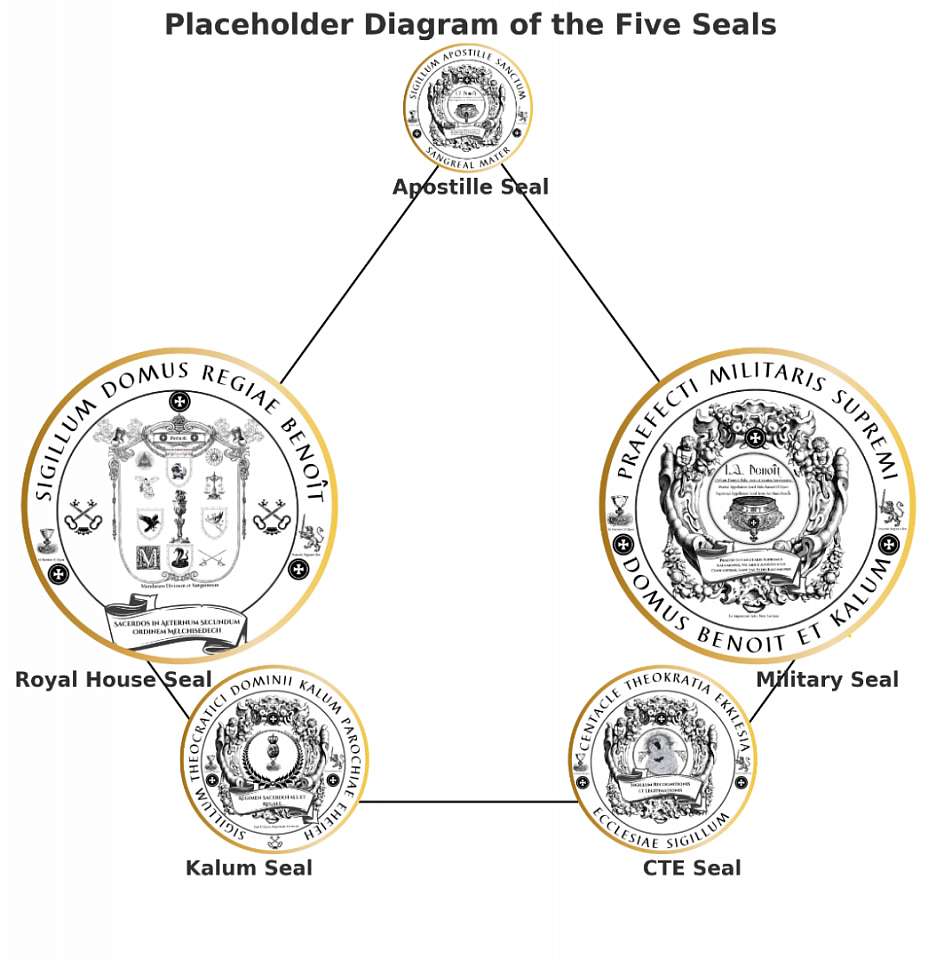
Explanatory Notes on the Seals of Governance
1. Oracle (Ekklesia Seal — Divine Mandate)
Seal of the Centacle Ekklesia — the unity of priesthood and rite, the mystical body of the Church (cf. Augustine, City of God, XIX.17)[3].
Governs rites, liturgy, doctrine, and apostolic succession.
Authority rooted in Canon Law (Corpus Juris Canonici), Melchizedek Priesthood (Hebrews 7:17 — “You are a priest forever, after the order of Melchizedek”), and continuity with ecclesiastical sovereignties.
Orders Ordo Draconis and Knights Templar of the Holy Rosy Cross are placed here, subordinate to Divine Wisdom (Sapientia).
2. Gateway (Apostille Seal — Divine & Bloodline Mandate)
Seal of the Sangreal Theocracy — the divine authority, the Mandate of Heaven as foundation (cf. Schmitt, Political Theology, 1922)[1].
- Issues IDs, Apostilles, decrees, and notarial acts.
- Affirmed by Roman Law (acta publica probant se ipsa — “public acts prove themselves”) and mirrored in Regulation (EU) No. 910/2014 (eIDAS), Article 25, giving notarized acts the force of self-authenticating law.
- Functionally serves as the payment gateway for dues, tithes, offerings, and inheritance access.
3. Royal House (Sanguinis Seal — Bloodline Mandate)
Seal of the House of Benoît — the royal and martial house, legitimized by blood (cf. Kantorowicz, The King’s Two Bodies, 1957)[2].
- Governs the Sangreal covenant and hereditary succession.
- Rooted in Psalm 24:1 (“The earth is the Lord’s and everything in it”), affirming that statutory land titles without blood covenant are void.
- Embodies lawful sanguinis jurisdiction, aligned to natural law and priest-king governance.
4. Military (Trinitarian Seal — Divine, Bloodline, Civic)
Seal of the Order of the Dragon — the guardianship of the sacrament and defense of the arcane, sign of the military orders (cf. Barber, The New Knighthood, 1994)[4].
- Guardianship of leylines and nexuses.
- Enforcement rooted in Vienna Convention on Diplomatic Relations (1961) (diplomatic immunity for officers) and Universal Declaration of Human Rights (1948), Articles 3 & 9 (protection from unlawful detention).
- Oversees Correctional Rite Houses, restoring offenders through oath renewal rather than punitive incarceration.
5. Civic Governance (Kalum Seal — Civic Mandate)
Seal of Kalum — the law of nations and the body of the nation, according to the Montevideo Convention (1933)[5].
Establishes the Constitution, civic IDs, and diplomatic relations.
Recognized under Montevideo Convention (1933), Article 1, as Kalum possesses:
1. Permanent citizenry;
2. Defined governance (canon + civic law);
3. Capacity for international relations;
4. Non-territorial jurisdiction (telluric current governance).
Sovereignty affirmed by the acknowledgment of 147 states, notarized acts standing as binding under international law.
🔹 Aeonic Note:
Kalum governance predates temporal states, revived and eternally renewed through the Covenant of the Sangreal Bloodline with El Elyon (Genesis 14:18-20; Hebrews 7). Temporal dates are maintained only as mortal record-keeping; the dominion is regnum perpetuum.
