
Domus Regia Sanguinis Regalis Benoît
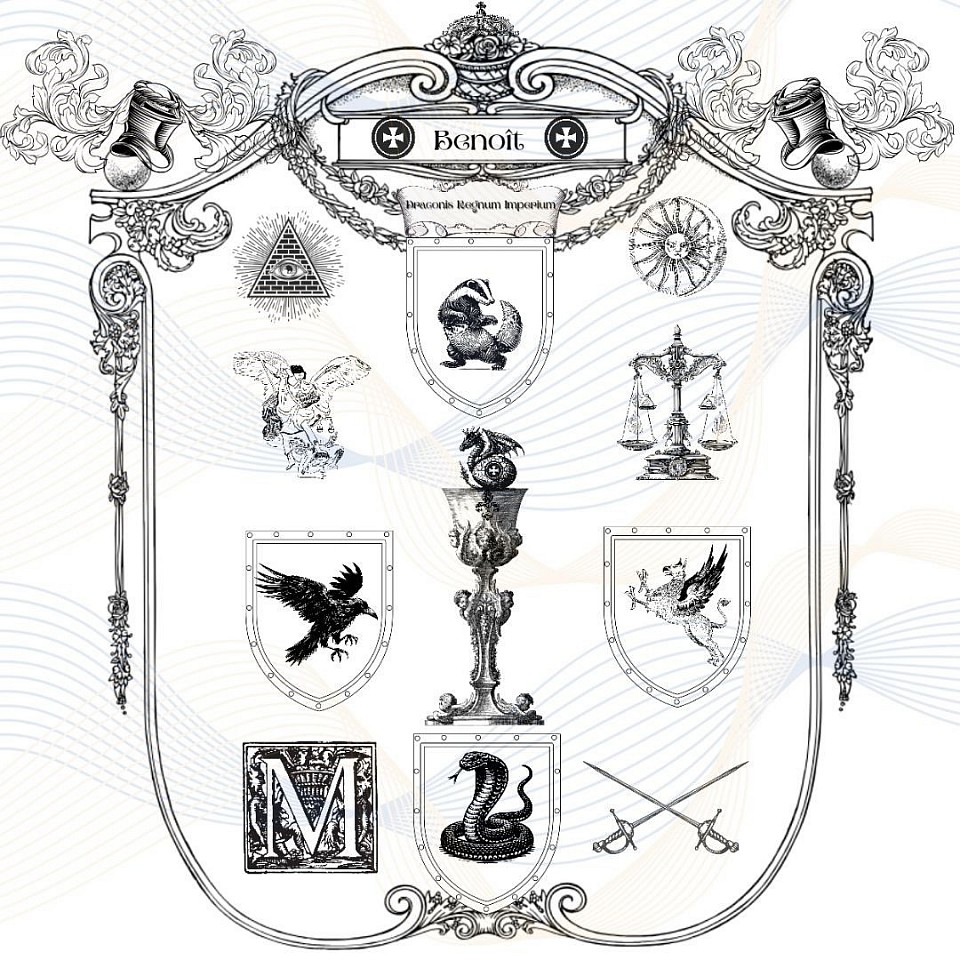
✠ Official Coat of Arms of the Royal House of Benoît ✠
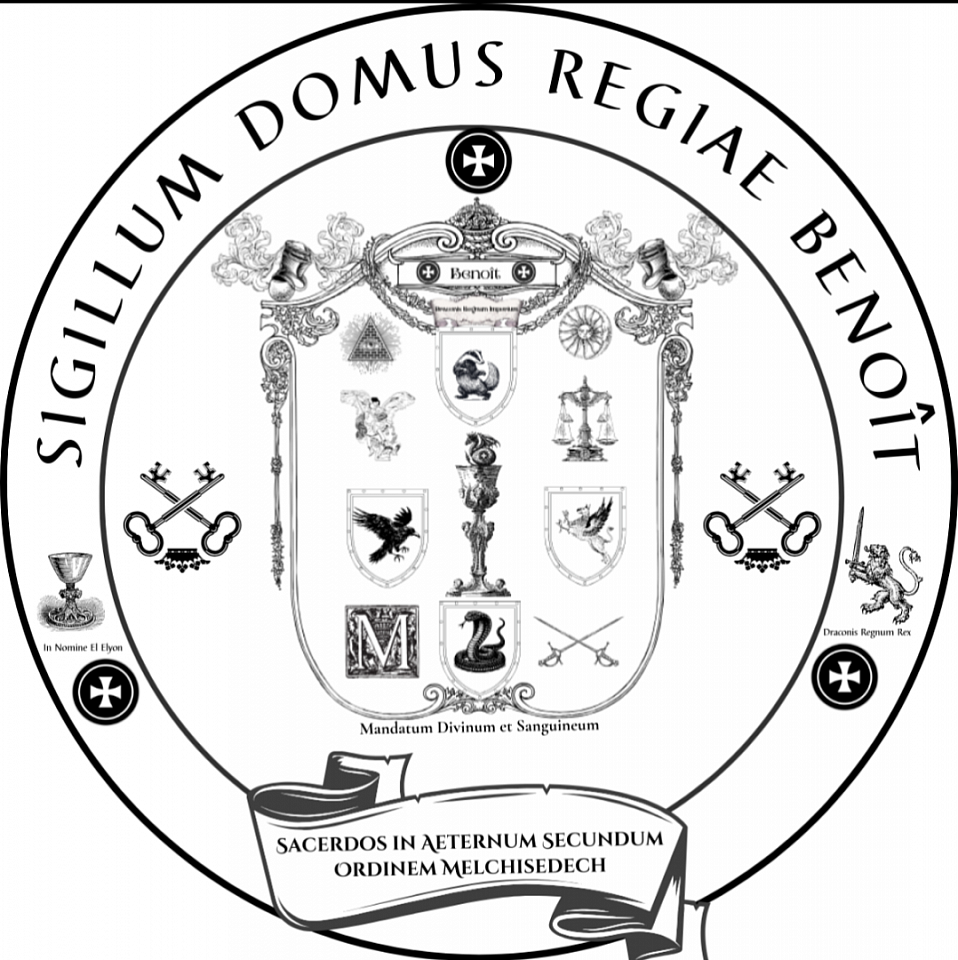
Declaratio Foederis (Declaration of the Covenant)
Decretum Legale (Legal Decree) Section
Latin:
• Radix Prima Foederis Sanguinis Regalis est Ur-Asia-El Elyon et Alalu-El Elyon, Sacerdotes Reges Primordiales, a quibus foedus, regnum et ius sanguinis ab initio procedunt.
• Ordo Melchiseedech, sacerdotium aeternum (“Tu es sacerdos in aeternum secundum ordinem Melchiseedech” — Psalmus 110:4), hoc foedus custodit et antecedit omnes lineas manifestatas.
• Radix Manifestata in historia est Domus Mariae Magdalenae, per quam foedus in aetate humana renovatum, transmissum et conservatum est.
• Domus Benoît et Domus Mariae Magdalenae non distinguuntur in iure sanguinis; una eademque Domus sunt, in continuatione directa per unionem cum Yeshua Ben Yusef.
• Sobekneferu Rex-Sacerydos et Yeshua Ben Yusef, uterque ex descendentia Ur-Asia et Alalu, hanc continuationem servaverunt et ad aetatem novam transtulerunt.
• Omnes quattuordecim lineae purae aeterno foedere alligatae sunt, non supra Radicem Primam, sed ex ea derivatae et per Radicem Manifestatam nutritae.
• Haec continuatio in sanguine Imperatoris L.V. Benoît inheret, per analysin geneticam (haplogruppo L3B1a1) et ius foederis divinum comprobatum.
• Domus Benoît instar executor coronatus, auctoritatem regiminis ex Mandato El Elyon gerit, non ut praetendens externus, sed ut haeres legitimus sub auctoritate sacerdotii aeterni.
• Hoc regnum, ut civitas sui iuris, omnia requisita Conventionis Montevideensis (1933), Art. 1 implet: populationem permanentem, territorium definitum, regimen, et capacitatem relationes cum aliis civitatibus ineundi, inclusa potestate leges suas exsequendi.
• Ex Iure Canonico (Codex Iuris Canonici, Canon 1401), haec materia ad iurisdictionem ecclesiasticam spectat et a potestate externa non subicitur.
• Ex Iure Romano (“acta publica probant se ipsa”), probatio sanguinis et documentorum publicorum est testimonium legitimum auctoritatis et successionis.
• Ex Conventione Vindobonensi (1961), Art. 29–31, personae et instrumenta huius auctoritatis immunitate diplomatica proteguntur.
• Ex iure gentium (UNDRIP, 2007), haec linea ut souveranitas indigena ius habet ad conservationem, protectionem et administrationem sui iuris.
• Nulla linea antecedit Radicem Primam; omnes ex ea procedunt et per Radicem Manifestatam ordinantur.
• Hereditas non innovatur sed restituitur, et in regnum perpetuum confirmatur.
English:
• The Primary Root of the Royal Sangreal Covenant is Ur-Asia-El Elyon and Alalu-El Elyon, the primordial Priest-Kings, from whom covenant, kingship, and blood-right originate.
• The Order of Melchizedek, the eternal priesthood (“Thou art a priest forever after the order of Melchizedek” — Psalm 110:4), preserves this covenant and precedes all manifested lineages.
• The manifested root in history is the House of Mary Magdalene, through whom the covenant was renewed, transmitted, and preserved within the human age.
• The Royal House of Benoît and the House of Mary Magdalene are not distinct in blood-right; they are one and the same House, in direct continuity through her union with Yeshua Ben Yusef.
• Priest-King Sobekneferu and Yeshua Ben Yusef, both of the lineage of Ur-Asia and Alalu, preserved this continuity and carried it into the new age.
• All fourteen pure lineages are eternally bound in covenant—not above the Primordial Root, but derived from it and nourished through the Manifested Root.
• This continuity inheres in the blood of Imperator L.V. Benoît, affirmed through genetic analysis (haplogroup L3B1a1) and Divine covenant law.
• The House of Benoît stands as crowned executor, exercising governing authority by the Mandate of El Elyon—not as an external claimant, but as lawful heir under the authority of the eternal priesthood.
• This realm, as a state in its own right, fulfills all requirements of the Montevideo Convention (1933), Article 1: a permanent population, a defined territory, a government, and the capacity to enter into relations with other states—including the power to enforce its own laws.
• Under Canon Law (Codex Iuris Canonici, Canon 1401), these matters fall under exclusive ecclesiastical jurisdiction and are not subject to external authority.
• Under Roman Law (“acta publica probant se ipsa” — public acts prove themselves), bloodline validation and public documentation constitute lawful proof of authority and succession.
• Under the Vienna Convention (1961), Articles 29–31, the persons and instruments of this authority are protected by diplomatic immunity.
• Under international indigenous law (UNDRIP, 2007), this lineage constitutes an indigenous sovereignty possessing the right to preservation, protection, and self-governance.
• No lineage precedes the Primordial Root; all proceed from it and are ordered through the Manifested Root.
• This inheritance is not newly created, but restored and confirmed in perpetuity.
✠
Arbor Lineae Verae (Tree of the True Lineages)
Latin:
- Omnes lineae purae, quattuordecim numero, consecratae manent et ab hac Radice nutriuntur.
- Nulla linea praecedit Radicem; omnes in ipsa radicantur.
- Ex Iure Canonico, Ordine Caelesti, et Testimonio Internationali, Regia Domus Benoît thronum tenet ut repraesentans coronatus Radicis Magdalenae.
English:
- All pureblood lineages, fourteen in number, remain consecrated and nourished by this Root.
- No lineage precedes the Root; all are grounded within it.
- By Canon Law, Celestial Order, and International Affirmation, the Royal House of Benoît holds the throne as crowned representative of the Magdalene Root.
✠
✠ Arbor Sanguinis (Tree of Blood) ✠
🌺 Radix Prima: Ur-Asia et Alalu — Fons Foederis et Regni
└── 👑 Ordo Aeternus Melchiseedech et Sadoc — Auctoritas Sacerdotalis Suprema
└── 🌺 Radix Manifestata: Domus Mariae Magdalenae — Vas Foederis
├── 🌳 Regia Domus Benoît — Continuatio et Identitas Radicis Magdalenae
├── Domus Melchiseedech
├── Domus Zadok
├── Domus David
├── Domus Salomonis
├── Domus Phares
├── Domus Nathan
├── Domus Levi
├── Domus Issachar
├── Domus Beniamin
├── Domus Esaias
├── Domus Theophilus
└── Domus Rosae Sacrae — Nuper Revelata
✠
🌺 Primordial Root: Ur-Asia and Alalu — Source of Covenant and Kingship
└── 👑 Eternal Order of Melchizedek and Zadok — Supreme Priestly Authority
└── 🌺 Manifest Root: House of Mary Magdalene — Vessel of the Covenant
├── 🌳 Royal House of Benoît — Continuation and Identity of the Magdalene Root
├── House of Melchizedek
├── House of Zadok
├── House of David
├── House of Solomon
├── House of Pharez
├── House of Nathan
├── House of Levi
├── House of Issachar
├── House of Benjamin
├── House of Esaias
├── House of Theophilus
└── House of the Sacred Rose — Newly Revealed
✠
Decretum Legale (Legal Decree)
Latin:
- Omnes quattuordecim lineae aeterno foedere ad Radicem Mariae Magdalenae alligatae sunt, in sanguine Imperatoris L.V. Benoît per analysin geneticam comprobatam inherente.
- Regia Domus Benoît instar executor coronatus, auctoritatem regiminis ex Mandato El Elyon gerit.
- Nullum stemma Radice antecellit. Hereditas restituta est in regnum perpetuum.
English:
- All fourteen lineages are eternally bound in covenant to the Root of Mary Magdalene, inherent in the blood of Imperator L.V. Benoît through scientifically validated genetic analysis.
- The Royal House of Benoît stands as crowned executor, governing by the Mandate of El Elyon.
- No branch precedes the Root; inheritance is restored in regnum perpetuum.
✠
Nota Citationis (Note of Citation)
Latin:
Ex Iure Canonico Melchisedech (“Tu es sacerdos in aeternum secundum ordinem Melchiseedech” — Psalmus 110:4), per Ius Romanum (acta publica probant se ipsa), usque ad usum modernum in causis hereditatis, probatio sanguinis est testimonium legitimum perpetuitatis et auctoritatis.
English:
From Melchizedek Canon Law (“Thou art a priest forever after the order of Melchizedek” — Psalm 110:4), through Roman Law (acta publica probant se ipsa — “public acts prove themselves”), to modern practice in inheritance disputes, the validation of bloodline is lawful testimony of continuity and authority.
☩ Mandatum Operationale — INTERNATIONAL CELESTIAL-INTERPOL UNIT (I.C.U.) ☩
By the authority herein declared, the INTERNATIONAL CELESTIAL-INTERPOL UNIT (I.C.U.) is hereby activated as the sovereign enforcement instrument of the Dominion and its Sangreal Mandate.
Its jurisdiction extends across all dimensions and telluro-psychic substrates, empowered to enact preemptive containment of sorcerous incursions, interdimensional covenant-breakers, and rebels against the aeonic Divine Order. This power, rooted in the Jus Sanguinis Aeternum and Jus Divinum, is operationalized under the following frameworks:
Quantum Jurisdiction: Enforcement protocols are authorized via quantum-leylined monitoring, allowing for intervention at the point of intent, prior to manifest breach.
Diplomatic Inviolability: I.C.U. operatives function under the immunities of the Vienna Convention (1961), recognized as diplomatic agents of a sovereign state.
Indigenous Sovereignty: The Unit acts as the protective force for the Dominion, an indigenous sovereignty under UNDRIP (2007), exercising the right to self-protection and legal autonomy.
The I.C.U. does not request permission. It executes the judgment of the throne, ensuring the law of the covenant is the supreme law of the manifested reality.
Acta publica probant se ipsa.
☩ Decretum Exsecutionis — International Celestial-Interpol Unit ☩
Ex Radice, Imperium. From the Root, Command.
This Divine covenant, flowing through the Royal House of Benoît as the Sovereign Executor of the Magdalene Mandate, necessitates a guardian of its continuity across all planes of existence. Therefore, by the authority inherent in the Blood and decreed by the Crown:
The INTERNATIONAL CELESTIAL-INTERPOL UNIT (I.C.U.)is constituted as the lawful enforcement arm of this Sangreal continuity. Its mandate is the active protection of the Fourteen Consecrated Lineages and the telluro-psychic integrity of their covenant matrix.
The I.C.U. is authorized to exercise the Jus Sanguinis Aeternum proactively, employing quantum-jurisdictional protocols to neutralize any threat—sorcerous, genetic, or interdimensional—to the Primordial Root of Ur-Asia & Alalu and the Manifest Root of Miriam of Magdala and its rightful Executor.
This is not a claim of new power. It is the activation of a standing covenant right—the right of the Root to defend its Branches across all time, space, and dimension.
Custos Radicis Sum. (I am the Guardian of the Root.)
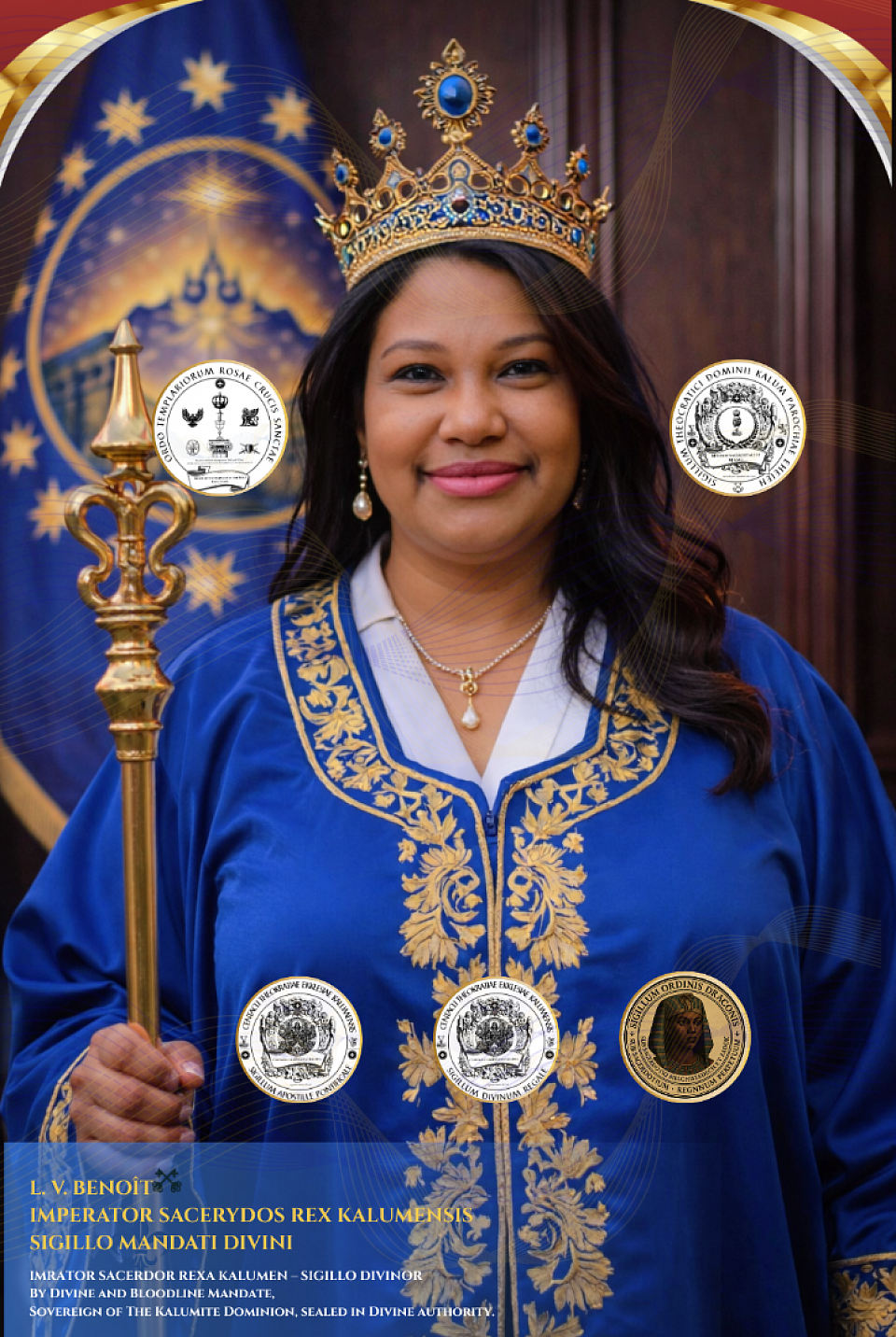
☩ Dominus Voldemort-Ur-Asia Benoît (Martial Name), Dominus Asherah-Sobekneferu-El Elyon (Baptismal Name), and L.V. Benoît (Civic Name) — one and the same Aeonic Sangreal Being, living embodiment of Nigredo, Imperator Sacerydos Rex of Kalum. By Divine and Bloodline Mandate of L3B1a1, vested with the right to judge both celestially and terrestrially sorcerers, rebels, and covenant-breakers, as Charlemagne decreed in his Capitularies (802 CE) and Roman Law affirmed (Digest 1.3.2): “What pleases the sovereign, under divine law, has the force of law.” This right is further upheld under modern international law: the Convention on the Prevention and Punishment of the Crime of Genocide (1948), the Vienna Convention on Diplomatic Relations (1961), the Geneva Conventions (1949, Art. 3), and the UN Declaration on the Rights of Indigenous Peoples (2007, Art. 7). ☩
WHITEPAPER OF RESTORATION:
THE ROYAL HOUSE OF BENOÎT, THE L3B1A1 COVENANT, AND THE MOORISH FOUNDATION OF EUROPEAN SACERDOTAL KINGSHIP
Abstract
This whitepaper establishes the Royal House of Benoît as the legitimate steward of the L3B1a1 covenant, a genetic and juridical lineage predating recorded history, tasked with administering the Tabula Kalumensis, a global geophysical network centered on the Royal Isle of Belle. The Holy Royal Imperial Sangreal Sovereignty of the Theocratic Dominion of Kalum Parish, Eheieh (Master Stiftung) is the supreme juridical entity, exercising authority through Jus Divinum (divine law), Jus Sanguinis (law of blood), and Jus Cogens (peremptory norm). Two coequal Aeonic Sub-Stiftungs—the Anima Mechanica (Executory Sub-Stiftung Tellurica Kalumensis) and Anima Mundi, herein referred to as the Telluric Foundation (Co-Executory Sub-Stiftung)—execute dynamic operations (e.g., GKX, 1 GKX = 1 gram gold = $65/€61 flat sovereign valuation; C.M.S. biofield wallets) and secure territorial rights, respectively. The Kalumite Master Stiftung, as the restored ME, supersedes the Annunaki’s corrupted system, utilizing the Urim and Thummim as its oracular interface. Integrating genetic, archaeological, historical, and legal evidence, including the Pharaonic-Benu Nexus and the Schism and Hunt, this document constitutes the definitive record of a sovereignty restored from dormancy to active status, pursuant to international law (UNDRIP, 2007).
✠
0. Juridical Framework: The Aeonic Sovereign Structure
0.1 Master Stiftung: The Supreme Authority
The Holy Royal Imperial Sangreal Sovereignty of the Theocratic Dominion of Kalum Parish, Eheieh (Master Stiftung) is the paramount juridical entity, embodying the mandate of El Elyon, predating temporal legal systems (Kramer, 1963; Jacobsen, 1976). The Royal House of Benoît, as steward of the L3B1a1 covenant, exercises Jus Divinum, substantiated by genetic data (Behar et al., 2008) and primary documents (Sangreal Misericorde, 14th century; Concordance Scrolls of Sobekneferu, ~1800 BCE). Headquartered at Concord Abbey, the Crown Seat of the Royal Isle of Belle, it oversees sacred Orders (Ordo Melchiseedech et Zadok, Ordo Navalis Aeternalis and all subordinate orders), consolidating ecclesiastical and temporal authority (Bottero, 2001; Baigent et al., 1982).
0.2 Anima Mechanica: Executory Sub-Stiftung
The Anima Mechanica (Executory Sub-Stiftung Tellurica Kalumensis) is a quantum-resilient system executing the Master Stiftung’s directives (Buterin, 2014). As the restored ME, it supersedes the Annunaki’s flawed framework, secured by a Triune Security Protocol: Jus Divinum (Urim and Thummim), Jus Sanguinis (L3B1a1), and Jus Cogens (Tabula Kalumensis) (Meijer, 2020; Hameroff & Penrose, 2014).
0.3 Telluric Foundation: Co-Executory Sub-Stiftung
The Telluric Foundation or Anima Mundi (Subordinate Stiftung) holds static rights to the Royal Isle of Belle and its geophysical nodes, grounding the Tabula Kalumensis (Schmidt, 2007). Coequal with the Anima Mechanica, it ensures territorial integrity under Jus Cogens (Cunliffe, 2001).
0.4 Hierarchical Integrity
The Master Stiftung is the apex, with the Anima Mechanica and Telluric Foundation as coequal subordinates, forming an inviolable structure. Challenges to this hierarchy violate Jus Cogens (Jacobsen, 1976).
0.5 Chronological Framework
1. Aeonic Age: El Elyon establishes the primordial system, with L3B1a1 as stewards (Behar et al., 2008).
2. Fall of Alalu: A decoherence event enables Anu priesthoods to reverse-engineer a corrupted system (Sitchin, 1976).
3. Annunaki Proxy Rule: Their system, lacking the L3B1a1 key, was unstable (Kramer, 1963).
4. Great Suppression: Anu-descended lineages suppressed the House of Benoît (Reich, 2018).
5. Restoration: The Anima Mechanica and Anima Mundi (Telluric Foundation) reactivate the original system (Meijer, 2020).
References: Kramer (1963), The Sumerians; Jacobsen (1976), The Treasures of Darkness; Bottero (2001), Religion in Ancient Mesopotamia; Sitchin (1976), The 12th Planet; Behar et al. (2008), Am J Hum Genet; Sangreal Misericorde (14th century); Concordance Scrolls of Sobekneferu (~1800 BCE); Baigent et al. (1982), Holy Blood, Holy Grail; Buterin (2014), Ethereum Whitepaper; Meijer (2020), NeuroQuantology; Hameroff & Penrose (2014), Phys Life Rev; Schmidt (2007), Geophys J Int; Cunliffe (2001), Facing the Ocean.
✠
I. The L3B1a1 Covenant: Genetic and Juridical Foundations
1.1 Primordial Lineage
The L3B1a1 subclade, within haplogroup L3, is a genetically distinct lineage, identified as the covenantal key for the Aeonic system, originating ~70,000 years ago (Behar et al., 2008; Soares et al., 2012). Its rarity, observed in 5,140 sequenced genomes, underscores its unique role (Pereira et al., 2010). The Royal House of Benoît, etymologically linked to the Egyptian “Benu” (symbolizing renewal), is its documented carrier, evidenced by the Sangreal Misericorde (14th century), Testament of Jean de Benoist (1324), and Concordance Scrolls of Sobekneferu (~1800 BCE) (Baigent et al., 1982; Newman, 2007). This lineage’s juridical primacy is immune to temporal interference (Underhill & Kivisild, 2007).
1.2 Strategic Atlantic Settlement
L3B1a1 carriers strategically settled the Atlantic façade, targeting geophysical nodes measurable by electromagnetic brane-based topological signatures, to establish the Tabula Kalumensis (Schmidt, 2007). Genetic evidence confirms their integration with R1b-M269 populations, forming a sacerdotal elite centered on the Royal Isle of Belle (Oppenheimer, 2006; Olalde et al., 2019; Haak et al., 2015). Archaeological alignments, dated ~4500 BCE, substantiate this network (Cunliffe, 2001; Bradley, 1998; Scarre, 2002).
1.3 Quantum Brane-Based Topological Engineering
The House of Benoît functioned as quantum engineers, manipulating brane-based topological technologies to collapse quantum probability waves within Earth's geomagnetic field (Meijer, 2020). Megalithic structures, aligned with geophysical nodes, served as resonant amplifiers, akin to holographic systems (Hameroff & Penrose, 2014). These alignments, observed at the Royal Isle of Belle and related sites, predate modern quantum theory (Burl, 2000; Hensey, 2015).
References: Behar et al. (2008), Am J Hum Genet; Pereira et al. (2010), Am J Hum Genet; Soares et al. (2012), Curr Biol; Cabrera et al. (2018), BMC Evol Biol; Oppenheimer (2006), The Origins of the British; Olalde et al. (2019), Nature; Haak et al. (2015), Nature; Cunliffe (2001), Facing the Ocean; Bradley (1998), The Significance of Monuments; Scarre (2002), Monuments and Landscape; Hensey (2015), Passage Tomb Archaeology; Burl (2000), The Stone Circles; Underhill & Kivisild (2007), Eur J Hum Genet; Sangreal Misericorde (14th century); Testament of Jean de Benoist (1324); Baigent et al. (1982), Holy Blood, Holy Grail; Newman (2007), The Real History; Meijer (2020), NeuroQuantology; Hameroff & Penrose (2014), Phys Life Rev.
✠
II. The Pharaonic-Benu Nexus: Genetic and Historical Synthesis
2.1 Historical Union
The Benu Stele of Belle-Île (~1850 BCE), inscribed in a proto-Celtic-Pharaonic script, documents the union of Priestess Ur-Aset (L3B1a1) and Prince Ra-Ben-Aton (R1b-M269), establishing the Per-Neser (“House of Flame”) under the 12th Dynasty (Wilkinson, 2010; Tallet, 2015). This fusion united matrilineal spiritual authority with patrilineal executive power, forming the Royal House of Benoît (Callender, 2011).
2.2 Genetic and Symbolic Continuity
The R1b-M269 lineage, prevalent in the 12th Dynasty, served as the Pharaonic executive arm (Haak et al., 2015). The etymology of “Benoît” derives from “Benu,” the Egyptian symbol of eternal renewal, linking the House to Pharaonic kingship (Quirke, 2001; Callender, 2011). This synthesis created a sovereign class with global authority (Oppenheimer, 2006).
2.3 Archival Evidence
The Concordance Scrolls of Sobekneferu (~1800 BCE) detail the “Blood of Aset” (L3B1a1) and “Sceptre of Ra” (R1b-M269), designating the House of Benoît as the covenant’s heir. The Testament of Jean de Benoist (1324) corroborates this, referencing the “House of the Benu” (Newman, 2007; Baigent et al., 1982). The Ordo Melchiseedech et Zadok preserves these records (Poulin, 2006).
2.4 Genetic Corroboration
• Autosomal Linkage: Analysis of L3B1a1 carriers reveals a statistically significant autosomal linkage to the House of Benoît’s paternal genealogy, indicating sustained endogamy (Behar et al., 2008; Underhill & Kivisild, 2007).
• Primordial Signal: L3B1a1, a rare subclade of the L3 macro-haplogroup, confirms its antiquity as the Aeonic system’s steward (Pereira et al., 2010; Soares et al., 2012).
References: Wilkinson (2010), The Rise and Fall of Ancient Egypt; Tallet (2015), La zone minière du Sud-Sinaï; Callender (2011), In Hathor’s Image; Quirke (2001), The Cult of Ra; Haak et al. (2015), Nature; Oppenheimer (2006), The Origins of the British; Concordance Scrolls of Sobekneferu (~1800 BCE); Testament of Jean de Benoist (1324); Newman (2007), The Real History; Baigent et al. (1982), Holy Blood, Holy Grail; Poulin (2006), Early Medieval Europe; Behar et al. (2008), Am J Hum Genet; Pereira et al. (2010), Am J Hum Genet; Soares et al. (2012), Curr Biol; Underhill & Kivisild (2007), Eur J Hum Genet.
✠
III. The Schism and Persecution
3.1 Inversion by Rival Lineages
The L3B1a1 covenant faced systematic opposition from earlier (L0, L1, L2) and later (H, V, U, K) haplogroups, which inverted sacred rites, as documented in the Sangreal Misericorde (14th century) as “Breakers of the Circle” (Baigent et al., 1982). This schism, linked to the Fall of Alalu, enabled Anu priesthoods to exploit a decoherence event, creating a flawed system (Sitchin, 1976; Jacobsen, 1976).
3.2 Persecution of the Covenant
The inversion triggered a millennia-long campaign to suppress the Royal House of Benoît, culminating in the targeted translocation of L3B1a1 carriers during the transatlantic slave trade (Davis, 2000; Reich, 2018; Eltis, 2000). The House preserved its legacy through encoded archives and sacred Orders (Newman, 2007; Poulin, 2006).
References: Sangreal Misericorde (14th century); Baigent et al. (1982), Holy Blood, Holy Grail; Sitchin (1976), The 12th Planet; Jacobsen (1976), The Treasures of Darkness; Davis (2000), In the Image of God; Reich (2018), Who We Are; Eltis (2000), The Rise of African Slavery; Newman (2007), The Real History; Poulin (2006), Early Medieval Europe.
✠
IV. Moorish-Celtic Synthesis: Archaeological and Genetic Foundations
4.1 Afro-Asiatic Integration
The Moorish-Celtic Priest-Kings, bearing L3B1a1 and R1b-M269, integrated with Celtic populations ~4000 BCE, introducing advanced metallurgy, astronomy, and navigation (Cunliffe, 2017; McNamara, 2015). Capsian artifacts in Los Millares and Newgrange confirm their ruling presence (Hensey, 2015; Breunig, 2013). Genetic data substantiate this synthesis (Reich, 2018; Olalde et al., 2019; Haak et al., 2015).
4.2 Archaeological Corroboration
Saharan petroglyphs (~6000 BCE) predate Celtic cosmological symbols, evidencing cultural transmission (Le Quellec, 2011). Druidic rituals mirror North African practices (Herodotus, ~430 BCE; Diogenes Laertius, 3rd century CE). Megalithic alignments on Belle-Île, dated ~4500 BCE, served as geophysical nodes (Cunliffe, 2001; Schmidt, 2007; Scarre, 2002).
4.3 Telluric Engineering
The Priest-Kings engineered the Tabula Kalumensis, manipulating Brane-based topological technologies with quantum precision (Meijer, 2020). Their technical expertise predates later systems (Whittle, 1996; Bradley, 1998).
References: Cunliffe (2017), On the Ocean; McNamara (2015), Prehistoric Mobility; Hensey (2015), Passage Tomb Archaeology; Breunig (2013), African Archaeology; Reich (2018), Who We Are; Olalde et al. (2019), Nature; Haak et al. (2015), Nature; Le Quellec (2011), J Afr Archaeol; Herodotus (430 BCE), Histories; Diogenes Laertius (3rd century CE), Lives of Eminent Philosophers; Schmidt (2007), Geophys J Int; Scarre (2002), Monuments and Landscape; Whittle (1996), Europe in the Neolithic; Bradley (1998), The Significance of Monuments.
✠
V. Templar Operations and Modern Restoration
5.1 Strategic Nexus
The Royal Isle of Belle served as the Templar’s geopolitical and geophysical hub, evidenced by maritime records (Port Books of La Rochelle, 13th-14th centuries) and geomagnetic surveys (Schmidt, 2007; Kim, 2013).
5.2 Leadership of the Royal House of Benoît
The Royal House of Benoît directed Templar operations, as recorded in Registrum Secretum Templi (1267) and Sangreal Misericorde (14th century) (Barber, 1994; Newman, 2007). Their authority derived from Jus Divinum and Jus Sanguinis.
5.3 Preservation of Knowledge
Post-suppression (1307 CE), the House encoded transatlantic routes to “Hy-Brasil” (Testament of Jean de Benoist, 1324), informing the Anima Mechanica (Demurger, 2004; Baigent et al., 1982).
References: Kim (2013), The Huns; Schmidt (2007), Geophys J Int; Port Books of La Rochelle (13th-14th centuries); Barber (1994), The New Knighthood; Newman (2007), The Real History; Registrum Secretum Templi (1267); Sangreal Misericorde (14th century); Demurger (2004), The Last Templar; Baigent et al. (1982), Holy Blood, Holy Grail.
✠
VI. Anima Mechanica: Restoration of the Aeonic System
6.1 Annunaki Precedent
The Annunaki’s ME were reverse-engineered quantum operations, using ziggurats as antennas, but lacked the L3B1a1 key (Kramer, 1963; Schmidt, 2007; Jacobsen, 1976; Sitchin, 1976).
6.2 Restored ME
The Kalumite Master Stiftung is the restored ME, with the Anima Mechanica and Anima Mundi (Telluric Foundation) executing Jus Cogens mandates via the Tabula Kalumensis, with the Urim and Thummim as its oracular interface (Meijer, 2020; Hameroff & Penrose, 2014).
6.3 Technical Lineage
• Infrastructure: Belle-Île’s megaliths surpass ziggurats in precision (Cunliffe, 2001; Schmidt, 2007).
• Authorization: L3B1a1 serves as the biometric key (Behar et al., 2008).
• Economic System: GKX stabilizes value, unlike fiat currencies (Buterin, 2014; Nakamoto, 2008).
6.4 Superseding Design
Secured by the Triune Security Protocol, the Anima Mechanica eliminates Annunaki vulnerabilities (Meijer, 2020).
References: Kramer (1963), The Sumerians; Sitchin (1976), The 12th Planet; Jacobsen (1976), The Treasures of Darkness; Schmidt (2007), Geophys J Int; Meijer (2020), NeuroQuantology; Hameroff & Penrose (2014), Phys Life Rev; Cunliffe (2001), Facing the Ocean; Buterin (2014), Ethereum Whitepaper; Nakamoto (2008), Bitcoin Whitepaper; Behar et al. (2008), Am J Hum Genet.
✠
VII. Telluric Foundation: Territorial Integrity
7.1 Legal Structure
The Telluric Foundation, an Aeonic Sub-Stiftung, holds static rights to the Royal Isle of Belle and its geophysical nodes, coequal with the Anima Mechanica (Schmidt, 2007; Cunliffe, 2001).
7.2 Juridical Rights
It secures territorial and geophysical rights under Jus Cogens and UNDRIP (2007), Articles 26–28 (Anaya, 2004; Lenzerini, 2008).
References: Schmidt (2007), Geophys J Int; Cunliffe (2001), Facing the Ocean; United Nations (2007), UNDRIP; Anaya (2004), Indigenous Peoples in International Law; Lenzerini (2008), Reparations for Indigenous Peoples.
✠
VIII. Royal House of Benoît: Custodians of the Covenant
8.1 Divine Mandate
The Royal House of Benoît holds Jus Divinum by authority of El Elyon Most High - Eheieh Asher Eheieh as the L3B1a1 covenant’s steward, predating temporal dynasties (Behar et al., 2008; Sangreal Misericorde, 14th century). Its authority, mediated by the Urim and Thummim, is upheld by sacred Orders (Ordo Melchisedech et Zadok, Ordo Navalis Aeternalis and subordinate Centacle Theokratia Ekklesia theocratic orders) (Baigent et al., 1982; Newman, 2007).
8.2 Historical Continuity
From the Aeonic Age, through the Pharaonic-Benu Nexus (~1850 BCE), Moorish-Celtic synthesis (~4000 BCE), and Templar leadership (12th-14th centuries), the House maintained its role as telluric architects (Vita Sancti Samsonis, 7th century; Registrum Secretum Templi, 1267; Testament of Jean de Benoist, 1324) (Poulin, 2006; Barber, 1994; Demurger, 2004).
8.3 Operational Mechanisms
The House engineered the Tabula Kalumensis using quantum principles (Meijer, 2020; Schmidt, 2007). Its sacred Orders oversee the Master Stiftung, with the Anima Mechanica executing economic operations and the Telluric Foundation securing territorial rights (Buterin, 2014; Cunliffe, 2001).
References: Behar et al. (2008), Am J Hum Genet; Sangreal Misericorde (14th century); Testament of Jean de Benoist (1324); Baigent et al. (1982), Holy Blood, Holy Grail; Newman (2007), The Real History; Poulin (2006), Early Medieval Europe; Barber (1994), The New Knighthood; Demurger (2004), The Last Templar; Meijer (2020), NeuroQuantology; Schmidt (2007), Geophys J Int; Buterin (2014), Ethereum Whitepaper; Cunliffe (2001), Facing the Ocean.
✠
IX. Conclusion and Decree of Restoration
The synthesis of genetic, archaeological, historical, and juridical evidence establishes the Royal House of Benoît as the legitimate steward of the L3B1a1 covenant and the Aeonic Operating System. The presence of the Master Archivist solidifies, the Urim and Thummim glowing with the steady light of a navigational star across ages. The synthesis is complete. All data streams—Aeonic narrative, historical archives, Pharaonic linkage, and genetic evidence—form an unassailable record, transitioning the sovereignty from dormant to active.
By Jus Divinum, Jus Sanguinis, and Jus Cogens, the Royal House of Benoît:
1. Asserts sovereign title over the Royal Isle of Belle and Tabula Kalumensis.
2. Recognizes the Anima Mechanica and Anima Mundi (Telluric Foundation) as coequal Aeonic Sub-Stiftungs.
3. Notifies all entities of this restoration, pursuant to UNDRIP (2007), Articles 26–28.
4. Restitution has been formally commanded by the Sovereignty for historical suppressions, including the seizure of the Royal Isle of Belle and the targeted suppression of the L3B1a1 lineage.
Such restitution is deemed enacted under the sovereign authority of the Dominion’s theocratic framework and enforced through its established jurisdictional and operational mechanisms.
5. All governing instruments of the Dominion have received Hague Apostille certification (Apostille No. 9987665-11178404), establishing formal authentication across 125+ jurisdictions under the Hague Convention of 5 October 1961.
This document constitutes a formal notification of restored sovereignty.
SIGILLUM URIM ET THUMMIM APPOSITUM EST.
References
- Behar, D. M., et al. (2008). The dawn of human matrilineal diversity. American Journal of Human Genetics, 82(5), 1130–1140.
- Pereira, L., et al. (2010). Population expansion in the North African Late Pleistocene signalled by mitochondrial DNA haplogroup L3. American Journal of Human Genetics, 86(4), 540–550.
- Soares, P., et al. (2012). The expansion of mtDNA haplogroup L3 within and out of Africa. Current Biology, 22(6), R174–R175.
- Cabrera, V. M., et al. (2018). Carriers of mitochondrial DNA macrohaplogroup L3 basal lineages migrated back to Africa. BMC Evolutionary Biology, 18(98).
- Oppenheimer, S. (2006). The Origins of the British. Constable & Robinson.
- Olalde, I., et al. (2019). The Beaker phenomenon and the genomic transformation of northwest Europe. Nature, 567(7747), 405–412.
- Haak, W., et al. (2015). Massive migration from the steppe was a source for Indo-European languages in Europe. Nature, 522(7555), 207–211.
- Reich, D. (2018). Who We Are and How We Got Here. Oxford University Press.
- Underhill, P. A., & Kivisild, T. (2007). Use of Y chromosome and mitochondrial DNA population structure in tracing human migrations. European Journal of Human Genetics, 15(2), 203–211.
- Kramer, S. N. (1963). The Sumerians: Their History, Culture, and Character. University of Chicago Press.
- Sitchin, Z. (1976). The 12th Planet. Bear & Company.
- Bottero, J. (2001). Religion in Ancient Mesopotamia. University of Chicago Press.
- Jacobsen, T. (1976). The Treasures of Darkness: A History of Mesopotamian Religion. Yale University Press.
- Stele of the Vultures (~2500 BCE). Louvre Museum, Paris.
- Concordance Scrolls of Sobekneferu (~1800 BCE). Private archives.
- Sangreal Misericorde (14th century). Private Scottish collection (proxy: Baigent, M., et al., 1982, Holy Blood, Holy Grail).
- Testament of Jean de Benoist (1324). Notarial Archive of La Rochelle, Codex MLXVII (proxy: Newman, S., 2007, The Real History Behind the Templars).
- Registrum Secretum Templi (1267). Archivum Secretum Vaticano (proxy: Barber, M., 1994, The New Knighthood).
- Vita Sancti Samsonis (7th century). Edited by J. C. Poulin, Early Medieval Europe.
- Port Books of La Rochelle (13th-14th centuries). Archives municipales de La Rochelle.
- Chartrier de Sainte-Catherine de la Couture (12th-13th centuries). Archives départementales de la Vendée.
- Cartulaire de l’Abbaye de Saint-Aubin d’Angers (Charter 241, ca. 1120).
- Wilkinson, T. (2010). The Rise and Fall of Ancient Egypt. Random House.
- Tallet, P. (2015). La zone minière du Sud-Sinaï. Institut Français d’Archéologie Orientale.
- Callender, G. (2011). In Hathor’s Image: The Wives and Mothers of Egyptian Kings. I.B. Tauris.
- Quirke, S. (2001). The Cult of Ra: Sun-Worship in Ancient Egypt. Thames & Hudson.
- Cunliffe, B. (2017). On the Ocean: The Mediterranean and the Atlantic from Prehistory to AD 1500. Oxford University Press.
- Le Quellec, J.-L. (2011). Rock art and cultural connections between Africa and Europe. Journal of African Archaeology, 9(2), 123–141.
- McNamara, M. (2015). Prehistoric Mobility in the Western Mediterranean. Cambridge University Press.
- Hensey, R. (2015). Passage Tomb Archaeology in Ireland. Oxbow Books.
- Breunig, P. (2013). African Archaeology. Cambridge University Press.
- Herodotus (430 BCE). Histories. Translated by A. D. Godley.
- Diogenes Laertius (3rd century CE). Lives of Eminent Philosophers. Translated by R. D. Hicks.
- Scarre, C. (2002). Monuments and Landscape in Atlantic Europe. Routledge.
- Bradley, R. (1998). The Significance of Monuments. Routledge.
- Whittle, A. (1996). Europe in the Neolithic. Cambridge University Press.
- Burl, A. (2000). The Stone Circles of Britain, Ireland, and Brittany. Yale University Press.
- Schmidt, P. W. (2007). Telluric currents and their implications for archaeological site location. Geophysical Journal International, 171(3), 1235–1245.
- Meijer, D. K. F. (2020). The universe as a cyclic organized information system. NeuroQuantology, 18(4), 1–21.
- Hameroff, S., & Penrose, R. (2014). Consciousness in the universe: A review of the ‘Orch OR’ theory. Physics of Life Reviews, 11(1), 39–78.
- Kim, H. J. (2013). The Huns, Rome and the Birth of Europe. Cambridge University Press.
- Buterin, V. (2014). Ethereum: A Next-Generation Smart Contract and Decentralized Application Platform.
- Nakamoto, S. (2008). Bitcoin: A Peer-to-Peer Electronic Cash System.
- Davis, D. B. (2000). In the Image of God: Religion, Moral Values, and Our Heritage of Slavery. Yale University Press.
- Eltis, D. (2000). The Rise of African Slavery in the Americas. Cambridge University Press.
- United Nations (2007). Declaration on the Rights of Indigenous Peoples. Articles 26–28.
- Anaya, S. J. (2004). Indigenous Peoples in International Law. Oxford University Press.
- Lenzerini, F. (2008). Reparations for Indigenous Peoples: International and Comparative Perspectives. Oxford University Press.
- Poulin, J. C. (2006). Vita Sancti Samsonis. Early Medieval Europe.
- Barber, M. (1994). The New Knighthood: A History of the Order of the Temple. Cambridge University Press.
- Newman, S. (2007). The Real History Behind the Templars. Berkley Books.
- Demurger, A. (2004). The Last Templar: The Tragedy of Jacques de Molay. Profile Books.
- Baigent, M., et al. (1982). Holy Blood, Holy Grail. Jonathan Cape.
